
Multi-pitch · Engelberg · Titlis
Titlis South Face Climbing – SE Pillar, Incas, Tumi and other routes
The south face of the Titlis combines steep limestone climbing with a high-alpine environment. From the classic south-east pillar to demanding face routes, the selection extends above the Firnalpelifirn.
The wall is around 500 metres high, with some lines continuing beyond that to the summit. The approach, snow on the ledges and the return journey are all part of the whole undertaking. Two projects mentioned in the overview are not listed as finished routes.
- Difficulties
- 6b+ to 7a according to the tables
- Length
- 7–26 SL depending on the route
- boarding
- Via Klein Titlis / Grassenbiwak
- Hedging
- Alpine furnished
- Entry points
- approx. 2550 m
- Season
- June to October, depending on conditions
- Exhibition
- South
- Wall height
- approx. 500 m
To get started
Access description
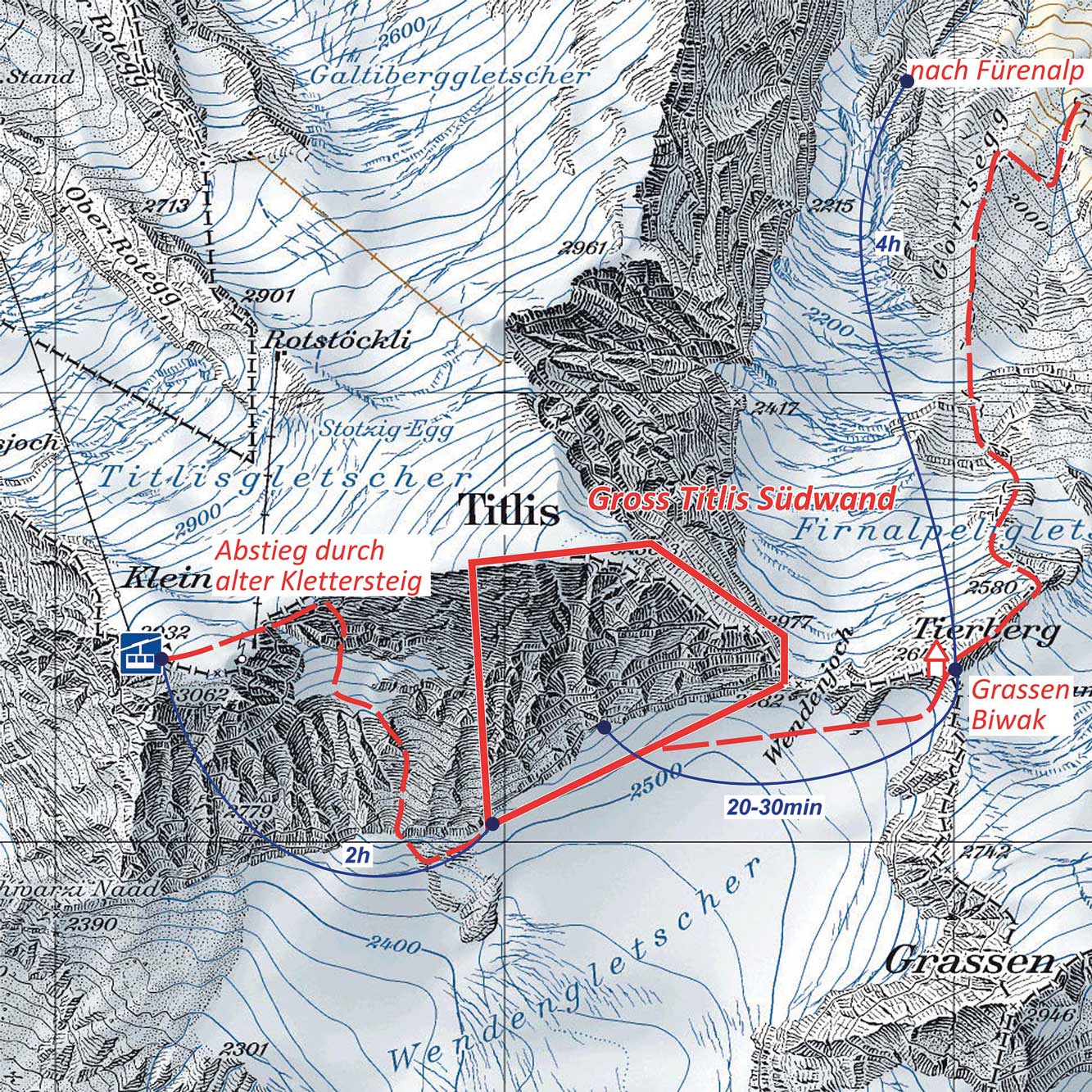
From Klein Titlis
Take the train to Klein Titlis. From there, descend via the route of the former south face via ferrata and traverse across the glacier terrain to your chosen line. The former via ferrata is no longer maintained; most of the wire ropes have been removed. High-altitude hike: Klein Titlis via the south face ↗
About the Grassen Bivouac
Alternatively from the Engelbergertal valley to the bivouac and onwards to the base of the wall. The Grassen Bivouac lies at 2,647 m. The SAC grades the standard approach as T4 and around 4:45 hours. SAC: Ascent to the Grassen Bivouac ↗ The four-hour approach time in the route documentation is only a rough guide; allow extra time for the walk to the respective starting point.
Orientation on the wall
Wall overview

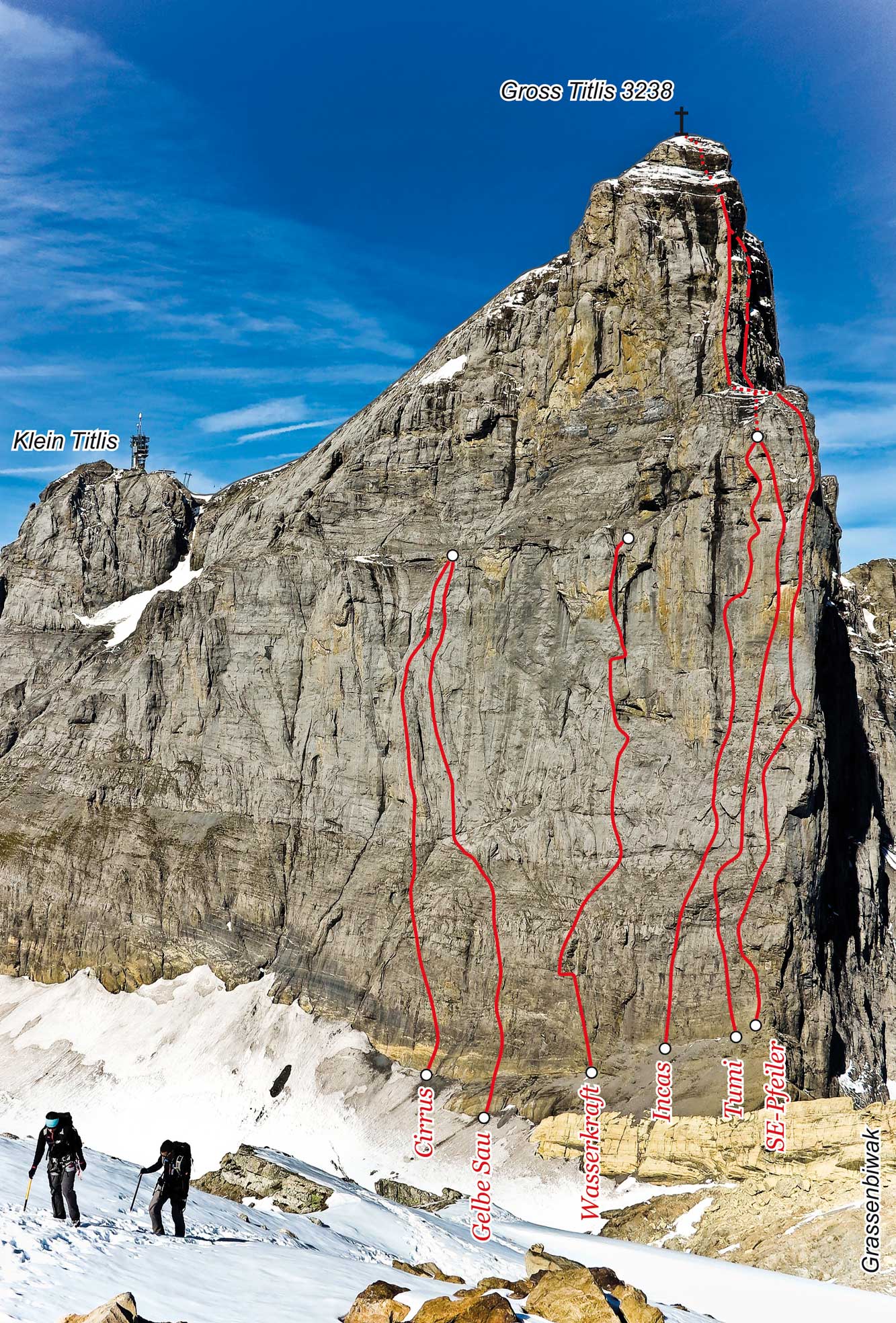
All details for the respective route
Routes and topos
SE pillar
- Length
- 26 SL
- Compulsory.
- 5c+ / A2
- Material
- 2 × 50 m according to the table; friends, nuts, hammer and pitons
- First ascent
- R. Bögli, J. Braun, R. Monnerat, M. Perrenoud, M. Zuckschwert & B. Meier, 1960
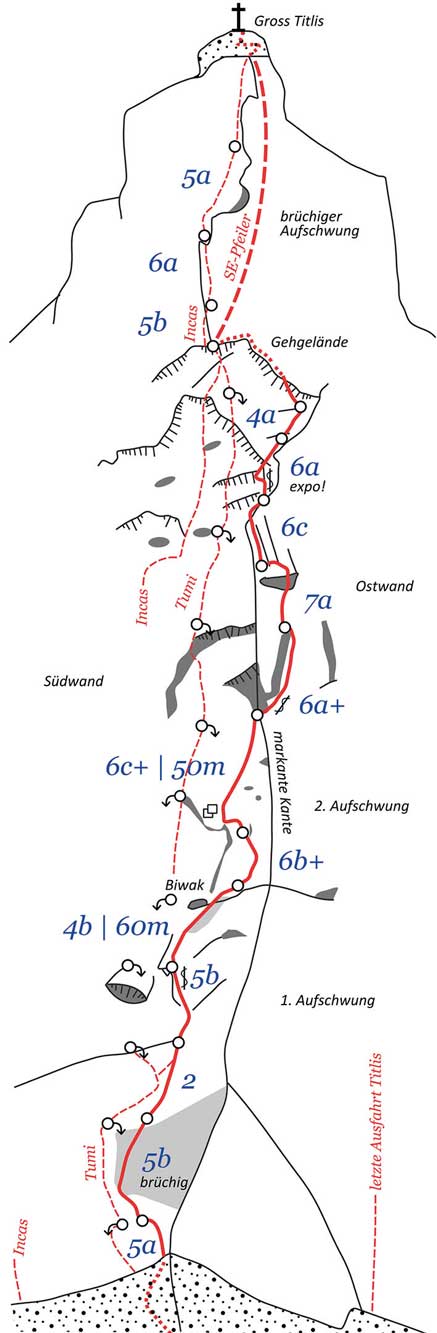
A long classic route to the summit. The first two pitches are described as loose; starting via Tumi is mentioned in the documentation as an alternative. Even with moderate compulsory free climbing, the technical and alpine commitment remains high.
Insurance Alpine; historical anchoring equipment, including some wooden wedges and old bolts.
The topo also lists a 60-m rope length. Do not use the table value of 2 × 50 m without checking the belay stations and rope routing first.
Incas
- Length
- 11 SL
- Compulsory.
- 6c
- Material
- 2 × 50 m; Friends 1–2.5; Nut set
- First ascent
- C. & Y. Remy, 1992
Technical wall climbing. The eighth pitch features an exposed 6c section described as having a dangerous fall potential. Return via the route or continue via Tumi to the summit.
Insurance Basically set up, mobile additions are part of it.

Tumi
- Length
- 15 SL
- Compulsory.
- 6b+
- Material
- 2 × 50 m; Friends 1–2.5; Nut set
- First ascent
- C. & Y. Remy, 1992
Tumi combines wall climbing with an alpine upper section. The guidebooks describe abseiling after eleven pitches or continuing on to the summit.
Insurance Expandable protection; fewer pegs in the upper section.
Ambush
- Length
- 20 SL
- Compulsory.
- 6b / A2
- Material
- Set of friends, set of pitons, hammer and pegs; plan the rope system according to the topo
- First ascent
- H. Howald & E. Neracher, 1981
A long line with intersections, ribbons and multiple bivouac options. The documented exit leads towards the summit; return via Klein Titlis.
Insurance Alpine; old material and technical sections.
The topo contains 55 m pitches. Plan your rope equipment accordingly; one pitch is not automatically an abseil length.

Hydropower
- Length
- 12 SL
- Compulsory.
- 5c+ / A1
- Material
- 2 × 50 m; Friends 1–2; Nut set
- First ascent
- P. Schoch, P. Ahi, Th. v. Atzigen & K. Winkler, 1988; renovated by P. Schoch 2010
Structured limestone with varied wall sections. Meltwater can keep the line wet even in autumn.
Insurance Mostly bolted; the last two pitches need to be trad-climbed.
The summary table lists 6b+, whereas the drawn topo contains differing individual grades.

Yellow sow
- Length
- 12 SL
- Compulsory.
- 6c
- Material
- 2 × 50 m; Friends 2, 2.5 and 4; Nut key set
- First ascent
- P. Schoch, D. Stalder & K. Winkler, 1988–2006
Above the scree ledge follow slabs and wall climbing with water channels and grippy structures. The changes to the glacier affect the start of the route.
Insurance Set up, supplement with mobile barriers.

Cirrus
- Length
- 11 SL
- Compulsory.
- 6c+
- Material
- 2 × 50 m; Friends 1–2; Nut set
- First ascent
- Ch. Wicki & T. Dollinger, 1996
Varied line with heavily featured limestone in the middle section. The route ends at the big ledge.
Insurance First pitch to be protected with traditional gear, then bolted.

Truth of Human Desire
- Length
- 7 SL
- Compulsory.
- Not specified
- Material
- 2 × 50 m; rocks / nuts; Friends 1–3 (double)
- First ascent
- K. Carrigan & M. Scheel, 1985
A short route relative to the wall height, but a serious alpine line. Cracks, a grey pillar and a loose overhang are noted in the topo. Top out on the ledge or plan your retreat.
Insurance Alpine and bold; long, self-protecting pitches.

Plan the tour right to the end
Descent and return journey
The return route depends on the route taken and the chosen exit point. Incas can be exited via the route or extended with Tumi. For Tumi, abseiling after eleven rope lengths is described; the full route continues to the summit. The SE Pillar and Handstreich require planning via the summit area towards Klein Titlis. Snow lying on ledges, loose rocks and the length of the abseiling sections must be factored into this planning.
This is what you bring to the table
Requirements and character
Besides safe climbing in the stated grades, you need experience in glacial terrain and with removable protection. A bolted route in this environment is not comparable to a climbing garden. The mandatory grades with A1 or A2 include artificial climbing sections.
For climbing route and return path
Equipment
The route-specific equipment is in every route box. In addition, the personal equipment includes:
- Climbing harness, helmet, climbing shoes and suitable mountaineering boots
- Belay and abseiling device, self-belay, screwgate carabiner and slings
- Mobile protection and rope system according to the chosen route and return path
- Glacier equipment with crampons, ice axe and crevasse rescue gear depending on the ascent route
- Head torch, weather protection, warm clothing, food and plenty of drinks
- Map and topos offline; bring bivouac gear if planning for multiple days
Additional knowledge
Frequently asked questions
Is the old via ferrata a normal via ferrata?
No. The former via ferrata is no longer maintained; the wire ropes have largely been removed. High-altitude hike: Klein Titlis via the south face ↗ The descent is an alpine route involving self-belaying and route finding.
Which routes can be combined?
Incas and Tumi share the overview topo. The continuation from Incas via Tumi to the summit is described. The connection and the additional length must fit into the time and equipment planning.
What does 5c+ / A2 mean on the SE Pillar?
The mandatory free-climbing grade does not describe the full difficulty: A2 stands for aid climbing. Experience with pitons, mobile protection and technical sections is additionally required.
Are there cooking facilities in the Grassen bivouac?
Cookware and a wood-burning stove are provided; please bring your own food. SAC: Equipment of the Grassen bivouac ↗
Can I go straight to the train at the exit?
At the top station, routes may change due to construction work. TITLIS: Route guidance information ↗
Dani Perret · IFMGA Mountain Guide
Titlis South Face with a mountain guide
Do you want to plan an alpine climbing tour? Write to me which routes you have already climbed and what you feel capable of. Together we will figure out which objective matches your experience and the conditions.

Alpine climbing with Dani
Discuss route selection and tour planning together.
View offer ↗Further goals
Similar climbing routes
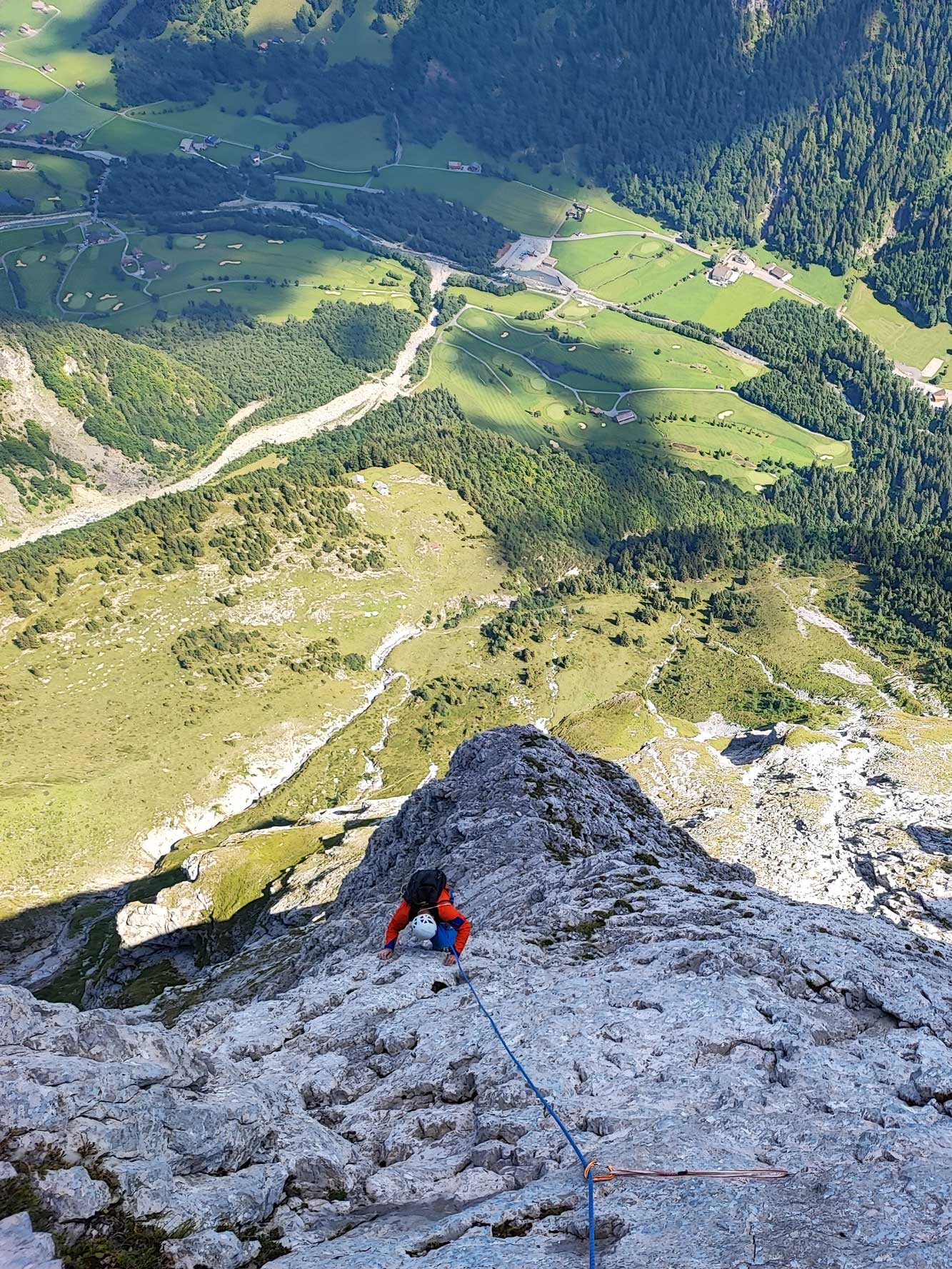
Titlis North Ridge «Via-Ruedi»
Long rock climb on the direct north ridge of the Titlis.
View tour ↗
Titlis North Face
Steep and demanding routes through the north face.
View tour ↗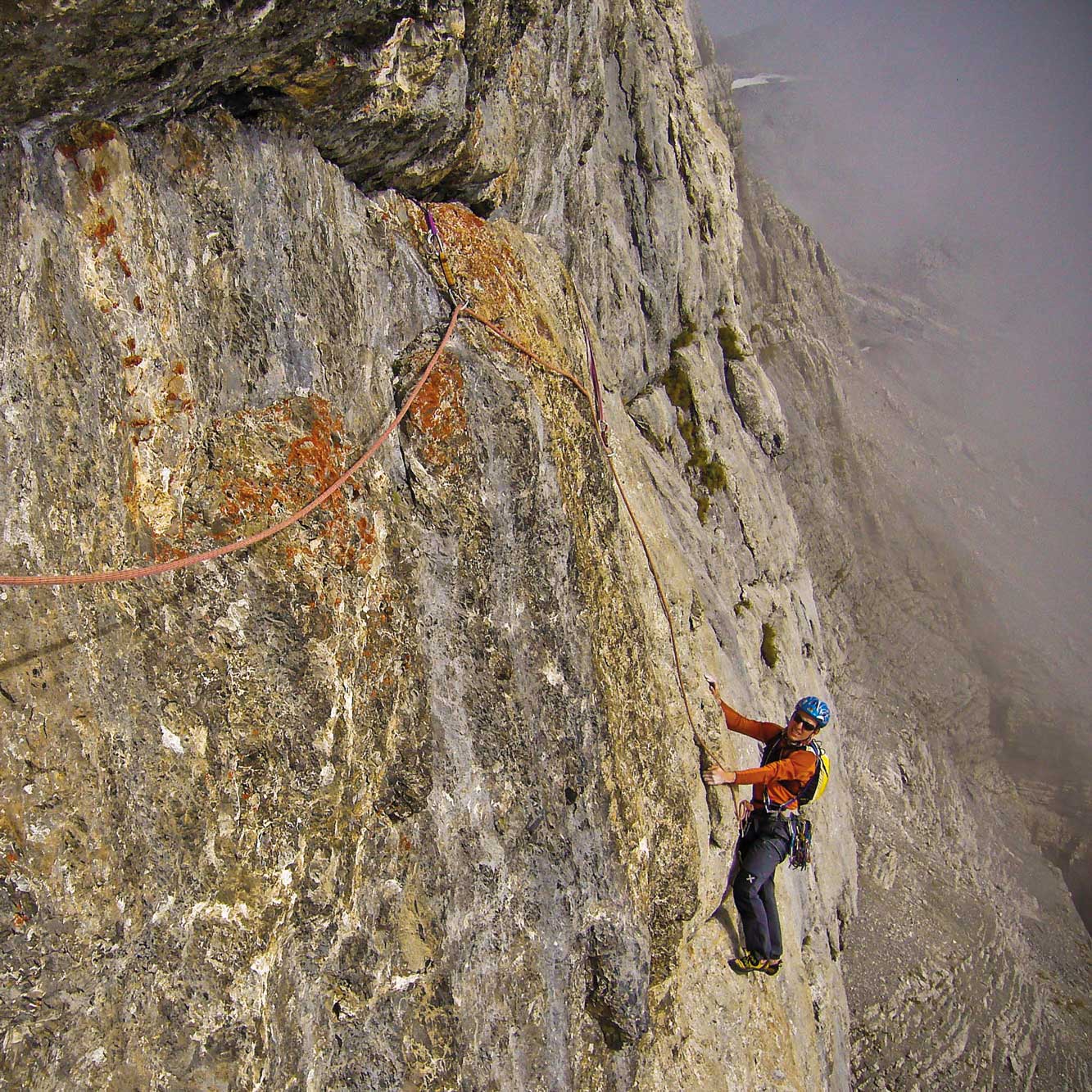
Ruchstock South Face
Multi-pitch routes above the Rugghubel Hut.
View tour ↗
Brunni Mountain School Circuit
Combination of wall climbing and ridges in the Brunni area.
View tour ↗


