
Intensive Avalanche Transceiver Training
and rescue of comrades
Train before every minute counts.
You've got your gear under control. Really?
KEEP IT UP. But train for the moment that counts.
You regularly go freeriding or ski touring. You have already attended an avalanche course, know your avalanche transceiver and are familiar with the probe and shovel.
Mostly everything goes smoothly. But when it goes wrong and someone is under the snow, suddenly only one thing matters: Time.
From experience I know: under this pressure, only procedures that are practised regularly work. That is precisely where we come in.
Suddenly, the crisis is upon us.
ALARM. Unannounced. Not on the training ground.
We are out skiing in a small group in the freeride terrain. Just normal.
And then: Alarm.
Somewhere on the terrain there is a prepared avalanche field. In it lie life-sized avalanche dummies like Mr Olsson, Jony Jumper, Frau Popov or Mr Eriksson.
You neither know in advance exactly when the emergency will happen, nor what awaits you.
Sounding.
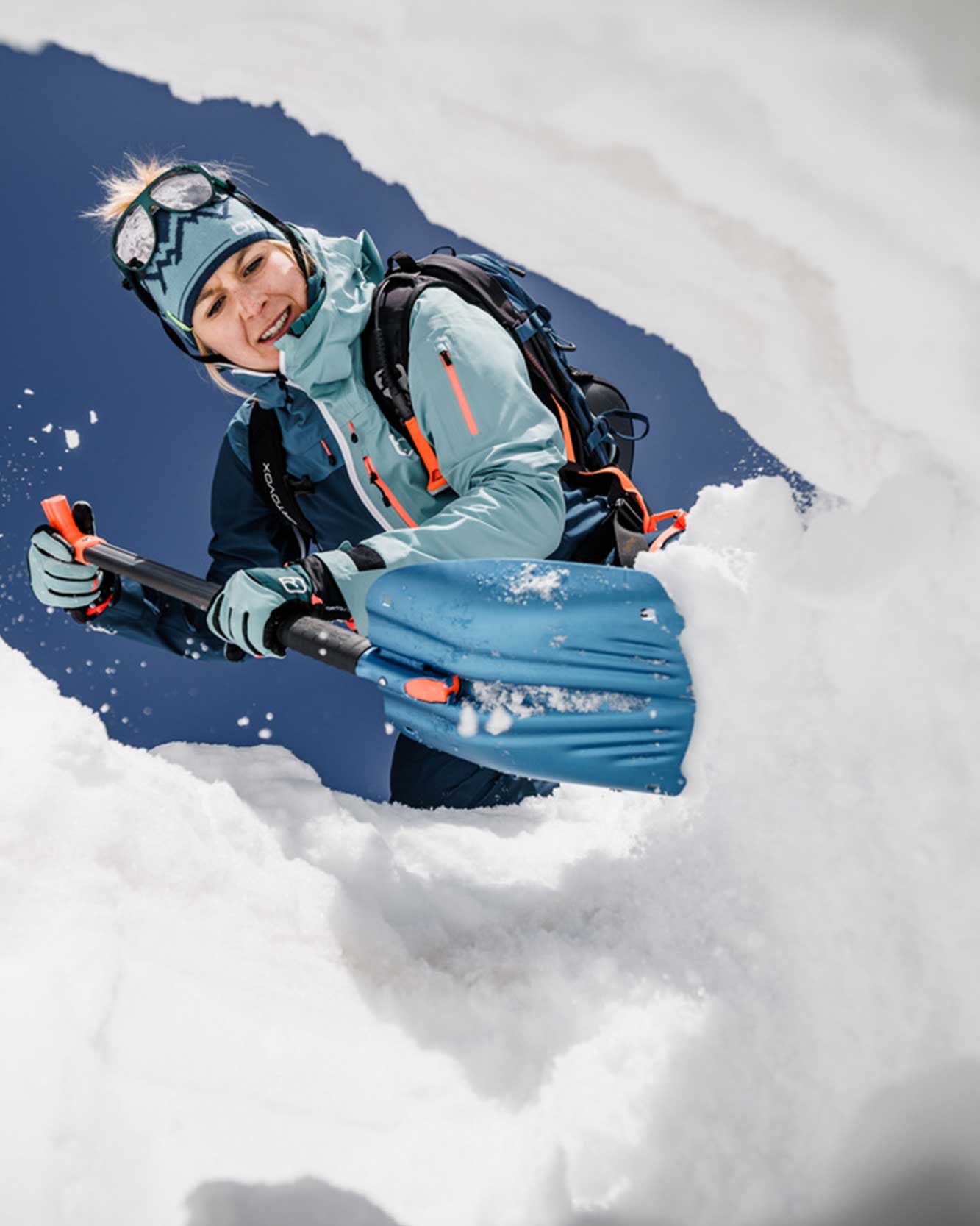
Digging out.
First aid.
Drive. Alarm. Rescue. Analyse. Repeat.
From the classic accident to multiple burials.
RAMP UP. Every scenario brings new difficulties.
Mr Olsson
The classic scenario: skier-triggered avalanche on descent.
- Signal search
- broad search
- Fine search
- Probing
- Efficient shovelling
- Initial assessment of the patient
The timer starts running from the moment you realise someone is missing.
Jony Jumper
Large avalanche debris. One person. More terrain, more decisions.
- Organisation
- search strategy
- Allocation of tasks
- Large search area
- Communication
- Time management
Now not only your transceiver decides – but your organisation.
Mrs Popov & Mr Eriksson
Two trapped. Two lives. One crew.
- Prioritise
- signal separation
- multiple burial
- Parallel tasks
- Teamwork
- First aid
Here it shows whether you know your drills – or whether rescue works as a system.
What worked?
ANALYSE. Then straight away again.
After diving in at the deep end, we will debrief the operation together.
Where was time lost? Was the search thorough? Was probing done correctly? How efficiently was it shovelled? Was communication clear?
This is followed by the next scenario – with the aim of solving it more systematically, calmly and quickly.
Included
- Organisation and implementation
- Guide's expenses
- IFMGA Mountain Guide or Aspirant Mountain Guide
- Prepared rescue scenarios
- life-sized avalanche dummies
- Evaluation and personal feedback
Exclusive
- Ski pass
- Arrival
- Lunch
- Personal winter sports equipment

A day of reality training.
DRIVE. RESCUE. IMPROVE.
Meeting in Engelberg, brief equipment check and heading out into the terrain.
We are off. The first scenario will come as unexpectedly as possible.
Lunch in a restaurant or independently, depending on the daily schedule and area.
Further scenarios, final analysis and market close in Engelberg.
A transmitter in a rucksack is not a human being.
EXACT. That is why we train with life-size dummies.
A hidden avalanche transceiver on a flat practice slope is a sensible starting point. However, it is not sufficient for a realistic rescue procedure.
Our dummies don't just need to be located. You have to ascertain the exact position, reach the body beneath the snow and dig it out completely.
Only then does a search exercise turn into a rescue scenario.
What's included?
READY. For freeride and rescue.
You need your normal freeride or ski touring equipment and complete avalanche emergency gear.
You can hire missing equipment in Engelberg.
rental equipmentWinter sports
- Ski or snowboard
- Ski or snowboard boots
- Ski poles with skis
- Helmet and ski goggles
- Warm winter clothing
- Gloves
Rescue
- LVS
- Probe
- Shovel
- Rucksack approx. 25–30 litres
- snack
- Drink
Dates
INVOLVED. One training session per winter is worth it.
Show all dates
All currently published avalanche transceiver training courses


A rescue day is good.
The complete package is better.
At the Pre-Season Camp we combine comrade rescue with avalanche prevention, freeriding, ski touring, alpine skills and ski technique.
Depending on the programme, you can also take part on just a single training day.
Peace comes from routine.
Not even practice. Repeat.
The critical procedures must work when heart rate and time pressure rise. Exactly for this reason, buddy rescue should not be trained only once in a lifetime.
Dani Perret
IFMGA Mountain Guide · Engelberg
Questions about avalanche transceiver intensive search
RIGHT. So you know what you're letting yourself in for.
Who is the avalanche transceiver (LVS) intensive search suitable for?
For freeriders and ski tourers who are already familiar with avalanche transceivers, probes and shovels, and want to practise companion rescue realistically.
Do I already need to have done an avalanche course?
Basic knowledge is very useful. The training is not intended as a first contact with avalanche transceiver, probe and shovel, but as consolidation and realistic practical training.
Why do we train with life-size dummies?
Because a rescue doesn't end with the pinpoint search. The exact position must be probed, the body reached and efficiently dug out.
Do I know beforehand when a scenario starts?
If possible, no. An important part of the training is the unexpected switch from a normal freeriding or ski touring day to rescue mode.
Do we also practise multiple burials?
Yes. Depending on the group and their level of training, more demanding scenarios with multiple buried casualties are also part of the training.
Does first aid count as well?
Yes. The procedure does not end with the digging out. The initial assessment and care of the buried person are also part of the scenario.
How often should I practise buddy rescue?
My recommendation is at least once a winter. The more regularly the procedures are repeated, the more likely they are to work even under stress.
Can missing material be hired?
Yes. You can organise missing avalanche or winter sports equipment in Engelberg.
rental equipmentEven more winter knowledge.
Rescue is only one part. Complement your training with avalanche prevention, terrain decisions and the complete pre-season programme.

Avalanche Safety for Freeriders
Avalanche bulletin, terrain and decision-making applied directly in the freeride area.
Freeride course
Avalanche ski touring course
Practise route planning, terrain management and decision-making on a real ski tour.
Ski touring course
THE COMPLETE WINTER TRAINING
Pre-Season Camp
Rescue, avalanche awareness, freeride, ski touring and ski technique.
Explore camp →When it happens, the clock is ticking.
TRAIN. Before every minute counts.


