
Wildlife Engelberg – Discover wild animals around Brunni
Contents
The wildlife in the Brunni area
The Brunni area above Engelberg is one of the most diverse habitats in Central Switzerland. Between mountain pastures, alpine meadows, rock faces and high-alpine regions, numerous animal species live that are perfectly adapted to life in the Alps.
The Brunni Trail provides a fascinating insight into this wildlife. Those who keep their eyes open can, with a little luck, observe marmots, spot golden eagles in the sky, or catch sight of chamois and ibex on the rocky slopes around Brunni and Bannalp.
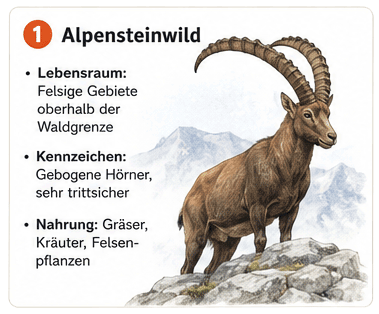
Alpine ibex – King of the rocks
Alongside the chamois, the Alpine ibex is arguably the best-known inhabitant of the Engelberg mountains. Its powerful build, short legs and large hooves give it astonishing sure-footedness in steep rocky terrain.
In the Brunni region, ibex colonies prefer to stay in rocky regions between 2,000 and 3,000 metres. The animals can often be observed on sun-exposed slopes, particularly in spring and autumn.
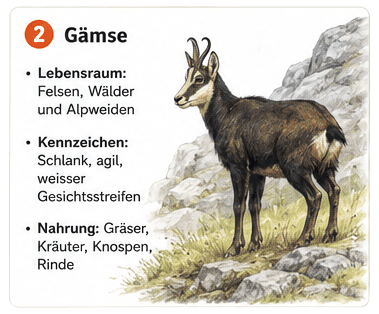
The chamois – the climber of the Alps
Chamois are among the most common wildlife around Engelberg. Unlike ibex, they regularly move between forest, alpine pastures and rocky terrain.
Particularly in the early morning hours, chamois can be observed above the tree line around Brunni, Bannalp or the Walenstöcke.
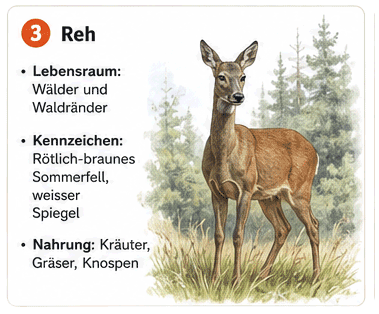
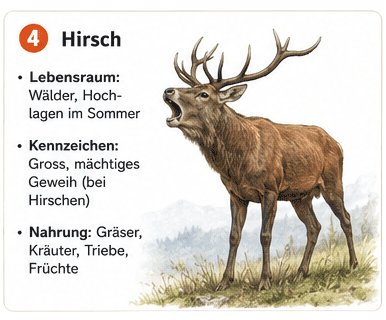
Roe deer and red deer in the Engelberg Valley
Whilst Alpine ibex and chamois live mainly in higher altitudes, roe deer and red deer prefer the forests and forest edges of the Engelberg Valley.
Red deer are the largest wild animals in the region. Particularly impressive is the red deer rut in autumn, when the stags compete for the hinds with loud roaring.
The Alpine marmot – symbol animal of Brunni
Above the tree line lives one of the most popular animals in the Alps: the marmot.
The strong front paws, flexible cervical spine and compact build are perfectly adapted to digging extensively branched burrows. Marmots spend a large part of their lives underground.
Marmots can be observed particularly frequently around the Brunni trail. With their warning whistles, they alert the entire colony to potential dangers.

Brown hare, fox and lynx
The European hare prefers open meadows and alpine pastures. Its long hind legs make it a fast and enduring runner.
The red fox is one of the most adaptable inhabitants of the Engelberg Valley. It lives in both forests and higher alpine regions, feeding on mice, insects, berries and carrion.
Significantly less often seen is the lynx. Europe's largest wildcat was reintroduced in Switzerland and nowadays also occurs in the forests of Central Switzerland. However, due to its shy way of life, it remains hidden from most visitors.
Golden eagle and goshawk – hunters of the skies
Anyone walking along the Brunnipfad should also keep an eye on the sky.
The golden eagle is one of the most impressive birds of prey in the Alps. With wingspans of over two metres, it uses the thermals along the rock faces and regularly circles above the mountains around Engelberg.
The goshawk, on the other hand, is a dweller of the forests. Its short wings and long tail enable rapid changes of direction between the trees.
Black grouse and ptarmigan
Two particularly sensitive bird species of the Alps live at the timberline.
The black grouse prefers open mountain forests and dwarf shrub heaths. The rock ptarmigan lives even higher up and is perfectly adapted to conditions above the tree line.
Its plumage changes with the seasons. In winter, it is almost entirely white, providing ideal camouflage in the snow.
Observing wildlife with respect
The wildlife around Brunni and Engelberg is fascinating, but also sensitive. Especially in winter, every flight costs valuable energy.
Anyone wishing to observe animals should stay on the marked paths, respect wildlife sanctuary zones, keep dogs on leads and maintain a sufficient distance.
This is how the unique wildlife around Engelberg will be preserved for future generations.
Further articles on mountain knowledge
- Marmots in Engelberg
- Golden eagle of the Uri Alps
- Wildlife quiet zones in Central Switzerland
- Flora of the Alps
- Glaciers around Engelberg
- Formation of the Alps near Engelberg


